
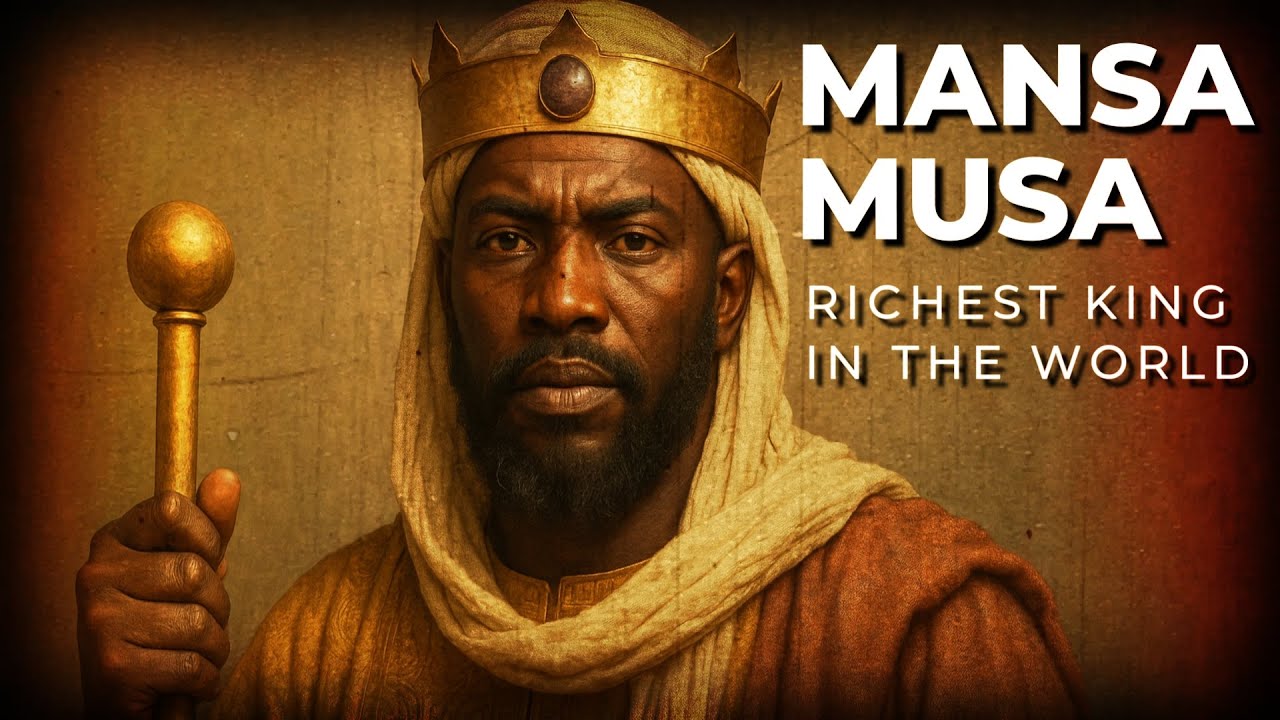
When we think about wealth today, names like Elon Musk and Jeff Bezos dominate headlines. But these modern billionaires pale in comparison to a 14th-century African emperor whose fortune was so vast that economists struggle to even calculate it. Meet Mansa Musa, the Mali Empire ruler whose net worth makes today’s richest people look modest by comparison.
Who Was Mansa Mansa Musa?
Mansa Musa I, born around 1280 in West Africa, became the tenth Mansa (meaning “king” or “emperor”) of the Mali Empire in 1312. His full name was Musa Keita I, and he ruled one of the most powerful and prosperous kingdoms in medieval history until his death around 1337.
The Mali Empire under Mansa Musa’s reign stretched across modern-day Mali, Mauritania, Senegal, Gambia, Guinea, Burkina Faso, Niger, Nigeria, and Chad. This wasn’t just territorial expansion—it was economic domination of unprecedented scale.
Early Life and Education
Unlike many historical figures, details about Mansa Musa’s early life remain somewhat mysterious. What we do know comes primarily from oral traditions preserved by West African griots (storytellers and historians) and writings by Arab scholars like Al-Umari and Ibn Khaldun.
Mansa Musa was born into the Keita dynasty, founded by the legendary Sundiata Keita. As a member of the royal family, he received education befitting a prince, learning about Islamic scholarship, governance, military strategy, and the intricate trade networks that made Mali wealthy.
He served as deputy to his predecessor, most likely his brother or cousin Abu-Bakr II (also called Abubakari II). When Abu-Bakr embarked on a mysterious expedition with 2,000 ships to explore the Atlantic Ocean and never returned, Mansa Musa ascended to the throne.
How Mansa Musa Built His Massive Fortune
The Gold Mines of Mali
The primary source of Mansa Musa’s incomprehensible wealth was gold—lots of it. The Mali Empire controlled the richest gold-producing regions in the medieval world, including the Bambuk and Bure goldfields. During his reign, historians estimate that Mali accounted for nearly half of the Old World’s gold supply.
Think about that for a moment: one empire, under one ruler, controlled half of all gold circulating across Africa, Europe, and Asia. This level of economic dominance has never been replicated in human history.
Salt and Trade Routes
But gold wasn’t his only revenue stream. The Mali Empire sat at the crossroads of major trans-Saharan trade routes. Salt, which was worth its weight in gold in many regions, flowed through Malian territories. Mansa Musa controlled both the supply and the trade routes, essentially running a medieval monopoly on two of the most valuable commodities of his time.
Timbuktu and Gao, cities within his empire, became legendary trading hubs where merchants from across Africa, the Middle East, and even Europe came to conduct business. Every transaction, every caravan that passed through—Mansa Musa’s empire took a cut.
Tribute and Taxation
As emperor of 24 annexed cities and countless territories, Mansa Musa collected tribute and taxes from his subjects. His administrative system was sophisticated for its era, ensuring a steady flow of wealth into the royal treasury from:
- Agricultural taxes from farming communities
- Trade tariffs on goods moving through his territory
- Tribute payments from vassal states
- Mining revenues from gold and salt operations
- Customs duties at trading posts
The 1324 Pilgrimage That Revealed His Wealth to the World
While Mansa Musa had been wealthy for years, the world didn’t fully comprehend the scale of his fortune until 1324, when he embarked on his famous Hajj pilgrimage to Mecca.
The Most Extravagant Journey in History
This wasn’t a quiet, humble pilgrimage. Mansa Musa traveled with an entourage estimated at 60,000 people, including:
- 12,000 enslaved people, each dressed in fine Persian silk
- Soldiers and royal guards
- His entire royal court
- Entertainers, musicians, and poets
- Doctors and advisors
- Hundreds of camels, each carrying 300 pounds of gold
According to historical accounts, even the enslaved people in his caravan wore expensive clothes and carried golden staffs. The sheer opulence of this traveling city left everyone who witnessed it absolutely stunned.
Breaking Egypt’s Economy
When Mansa Musa passed through Cairo, Egypt, his generosity became legendary—and economically disastrous. He gave away so much gold to the poor, spent lavishly on goods, and paid such extravagant prices for everything that he caused massive inflation.
The price of gold in Egypt plummeted, and it took the Egyptian economy twelve years to fully recover from Mansa Musa’s visit. He literally gave away so much wealth that he damaged an entire nation’s economy. Some historians estimate his pilgrimage caused over $1 billion in economic losses across the Middle East due to gold devaluation.
On his return journey, Mansa Musa recognized what he’d done and actually borrowed gold at high interest rates from Egyptian money-lenders to help stabilize the market. This is the only recorded instance in history where one person single-handedly controlled the entire gold industry’s pricing across multiple regions.
Expanding the Empire
The pilgrimage wasn’t just about religious devotion. Mansa Musa used it as an opportunity for diplomatic relations and territorial expansion. He annexed the cities of Gao and Timbuktu during his journey, further expanding his empire’s wealth and influence.
Mansa Musa Net Worth: How Much Was He Really Worth?
Here’s where things get challenging. Calculating Mansa Musa’s net worth in today’s money is nearly impossible, but economists and historians have tried.
The $400 Billion Estimate
The most commonly cited figure places Mansa Musa’s net worth at approximately $400 billion in today’s dollars. This calculation attempts to account for:
- The gold reserves he controlled
- Land and territorial wealth
- Trade revenue and taxation
- Tribute from vassal states
- Personal treasury holdings
However, many economic historians argue this number is actually far too conservative.
Why His Wealth May Be Incalculable
Rudolph Ware, a historian at the University of Michigan, told Money magazine: “This is the richest guy anyone has ever seen, that’s the point. They’re trying to find words to explain that.”
Contemporary accounts from Arab historians describe Mansa Musa’s wealth as “beyond description” and “incomprehensible.” The British Museum and other institutions note that attempting to convert his wealth into modern currency is problematic because:
- He controlled commodity supplies (gold and salt) that determined prices globally
- His wealth included non-monetary assets impossible to value (entire cities, trade routes, political power)
- The economic systems of medieval Africa operated differently from modern capitalism
- Inflation adjustments over 700 years become increasingly unreliable
Some historians suggest his true net worth could exceed $500 billion, $600 billion, or even approach the trillion-dollar mark. The honest answer is: we simply don’t know, but it was more than anyone else in recorded history.
Mansa Musa vs Modern Billionaires: The Ultimate Comparison
Let’s put this in perspective by comparing Mansa Musa to today’s wealthy elite.
Mansa Musa vs Elon Musk
As of February 2026, Elon Musk’s net worth fluctuates around $270 billion, making him one of the richest people alive. But even at his peak, Musk’s wealth doesn’t come close to Mansa Musa’s estimated $400+ billion.
More importantly, Musk’s wealth is tied to stock valuations of Tesla and SpaceX—it can go up or down dramatically. Mansa Musa’s wealth was in hard assets: gold, land, and commodities. His fortune was far more stable and tangible.
Mansa Musa vs Jeff Bezos
Amazon founder Jeff Bezos, worth approximately $210 billion as of 2026, ranks well behind Mansa Musa. While Bezos revolutionized e-commerce and built an empire, he doesn’t control fundamental commodities the way Mansa Musa controlled gold and salt.
Mansa Musa vs Historical Billionaires
Even compared to other historical wealthy figures, Mansa Musa stands alone:
- Augustus Caesar (Roman Emperor): Estimated $4.6 trillion (though this includes the entire Roman treasury, debatable as personal wealth)
- John D. Rockefeller: Approximately $340 billion adjusted for inflation
- Andrew Carnegie: Around $372 billion in today’s money
- Genghis Khan: Wealth tied to conquered lands, hard to quantify
- Jakob Fugger: Medieval banker, estimated $277 billion
Most historians agree that in terms of personal, controllable wealth relative to the global economy of his time, Mansa Musa remains unmatched.
Family Life: Wives, Children, and Dynasty
Unlike modern celebrity coverage, detailed personal information about Mansa Musa’s family life is limited. However, historical records and oral traditions provide some insights.
Marriages and Wives
As was customary for Islamic rulers of his era, Mansa Musa had multiple wives. Islamic law permits up to four wives, and as emperor, he likely had several marriages that served both personal and political purposes—forming alliances with powerful families within his empire.
Unfortunately, the names and specific details about his wives have been largely lost to history. Medieval Arab chroniclers focused more on his political and economic achievements than his personal relationships.
Children and Succession
Mansa Musa had several children, though again, specific names and numbers are debated among historians. What we know for certain is that he was succeeded by his son, Mansa Maghan (also known as Magha I), around 1337.
The succession didn’t go smoothly. Mansa Maghan’s reign was brief and weak compared to his father’s. Within a few years, power passed to Mansa Musa’s brother, Mansa Sulayman, who ruled for 24 years and managed to maintain much of the empire’s prosperity.
The Keita dynasty continued to rule Mali for generations, though none of Mansa Musa’s descendants achieved his level of wealth or power. The empire gradually declined after the mid-14th century due to:
- Internal conflicts and civil wars
- Pressure from neighboring kingdoms
- Loss of control over gold-producing regions
- The rise of competing trade routes
Career and Achievements: More Than Just Wealth
Mansa Musa’s legacy extends far beyond his bank account. He was a visionary leader who transformed his empire culturally, intellectually, and architecturally.
Architectural Legacy
During and after his pilgrimage, Mansa Musa commissioned numerous building projects:
Djinguereber Mosque: Built in Timbuktu in 1327, this mosque still stands today. Mansa Musa reportedly paid the Andalusian architect Abu Ishaq al-Sahili 440 pounds of gold—equivalent to over $8 million today—for designing it.
Sankore University: He established what became one of the world’s premier centers of Islamic learning. At its height, Sankore University housed one of the largest libraries in the world, with an estimated one million manuscripts covering subjects from astronomy to medicine to philosophy.
Palaces and Infrastructure: Throughout his empire, Mansa Musa built palaces, mosques, madrasas (schools), and improved infrastructure including roads and rest stops for travelers and traders.
Cultural Transformation
Under Mansa Musa’s patronage, Timbuktu transformed from a trading post into a legendary city of learning. He attracted:
- Islamic scholars from across Africa and the Middle East
- Poets and writers
- Mathematicians and astronomers
- Doctors and scientists
- Artisans and craftsmen
The University of Sankore became so renowned that students traveled thousands of miles to study there. It offered degrees in law, literature, medicine, astronomy, and Islamic studies—rivaling the great universities of Cairo, Baghdad, and eventually those emerging in Europe.
Diplomatic Relations
Mansa Musa’s pilgrimage established diplomatic and trade relationships with the Mamluk Sultanate of Egypt, the Marinid Sultanate of Morocco, and other Islamic kingdoms. These relationships brought:
- Cultural exchange and knowledge transfer
- Enhanced trade opportunities
- Political alliances
- Religious scholars and teachers to Mali
Administrative Reforms
Though less documented than his wealth, Mansa Musa implemented administrative systems that:
- Established fair taxation across his diverse empire
- Created a functioning legal system based on Islamic law
- Organized the military effectively
- Managed trade routes and commerce
- Maintained relative peace across 24 cities and numerous territories
Physical Appearance: What Did Mansa Musa Look Like?
Unfortunately, no authentic contemporary portraits or physical descriptions of Mansa Musa exist. The most famous image of him comes from the 1375 Catalan Atlas, a medieval map created by Spanish cartographer Abraham Cresques.
In this depiction, Mansa Musa sits on a throne, wearing a crown and holding a large gold nugget, with a golden scepter in his other hand. However, this wasn’t drawn from life—it was created decades after his death by a European who had never seen him.
What we can reasonably assume:
- He was likely of average height for 14th-century West Africans
- As emperor with access to the best food and healthcare of his era, he was probably healthy and well-fed
- He would have worn elaborate royal garments befitting his status
- Historical accounts emphasize his generosity and demeanor more than physical appearance
The focus on his appearance in medieval accounts centers on his royal bearing and the incredible wealth he displayed rather than specific physical features.
The Cultural Impact and Legacy of Mansa Musa
Putting Africa on the Medieval Map
Before Mansa Musa’s pilgrimage, much of Europe knew little about West Africa. His journey changed that dramatically. The Catalan Atlas placed Mali prominently on the map with Mansa Musa illustrated holding gold, establishing Africa’s reputation as a continent of wealth and powerful kingdoms.
This image influenced European perceptions for centuries, contributing to legends of African cities of gold and eventually motivating exploration—for better and worse—of the African continent.
Timbuktu as a Symbol
Thanks to Mansa Musa’s investments, Timbuktu became synonymous with wealth, learning, and mystery in Western imagination. Even today, saying something is “from here to Timbuktu” suggests an exotic, distant place of wonder.
The historical Timbuktu was indeed remarkable: a city in the Sahara Desert that became one of the world’s most important intellectual centers, housing hundreds of thousands of manuscripts on topics ranging from astronomy to poetry.
Inspiration for African Pride
In modern times, Mansa Musa has become an important symbol of African achievement and wealth before colonialism. His story challenges Eurocentric narratives of history and demonstrates the sophistication and power of pre-colonial African civilizations.
Educational movements, particularly in African diaspora communities, highlight Mansa Musa as evidence of Africa’s rich history of scholarship, economic power, and cultural achievement.
Why Mansa Musa’s Wealth Still Matters Today
Economic Lessons
Mansa Musa’s story offers several lessons relevant to modern economics:
- Resource Control: His wealth came from controlling scarce, valuable resources (gold and salt)
- Strategic Geography: Location at trade route crossroads created perpetual revenue
- Economic Impact: One person’s spending can affect entire regional economies
- Sustainable Wealth: Unlike quick fortunes, his wealth was built on renewable trade and mining operations
The Limits of Wealth Measurement
His incalculable net worth reminds us that true wealth encompasses more than dollars:
- Political power and influence
- Cultural and educational institutions
- Infrastructure and architectural legacy
- Diplomatic relationships
- Historical impact
Challenging Modern Assumptions
Mansa Musa’s story challenges several modern assumptions:
- That contemporary billionaires are the richest people ever
- That Africa was always impoverished or less developed
- That medieval societies were uniformly backward
- That wealth concentration is a uniquely modern phenomenon
What Happened to Mansa Musa’s Fortune?
After Mansa Musa died around 1337, his vast wealth didn’t disappear immediately, but it gradually dissipated for several reasons:
Poor Succession Management
His son, Mansa Maghan, lacked his father’s leadership abilities and couldn’t maintain control over the empire’s territories. Weak leadership led to loss of tribute and taxation revenue.
Fragmentation of the Empire
Within decades, the Mali Empire began fragmenting as:
- Vassal states declared independence
- Neighboring kingdoms seized territories
- Civil wars erupted over succession
- Trade routes shifted as political instability grew
The Songhai Empire
By the late 15th century, the Songhai Empire had risen to replace Mali as the dominant power in West Africa, taking control of Timbuktu, Gao, and the crucial gold-producing regions.
Loss of Monopolies
As the empire weakened, Mali lost its monopolistic control over:
- Gold mining regions
- Salt trade routes
- Trans-Saharan commerce
- Taxation of territories
The wealth didn’t vanish—it redistributed to new powers, new rulers, and new kingdoms across West Africa.
Mansa Musa in Popular Culture and Modern Recognition
Academic Recognition
Historians and economists consistently rank Mansa Musa as the wealthiest person in human history. Time magazine, Forbes, and major educational institutions cite him in discussions of historical wealth.
Educational Curricula
Many schools, particularly in the United States and Africa, now include Mansa Musa in world history curricula as an example of African achievement and medieval global economics.
Media Appearances
Mansa Musa has appeared in:
- Civilization Video Game Series: As a playable leader representing Mali
- Documentaries: Numerous historical documentaries about wealth, African history, and medieval trade
- Books: Both academic histories and popular non-fiction explore his life and impact
- Online Content: Countless videos, articles, and social media content discuss his wealth
Museums and Exhibitions
Museums across Africa, Europe, and North America have featured exhibitions about Mali Empire history, trans-Saharan trade, and Mansa Musa’s pilgrimage.
Frequently Asked Questions About Mansa Musa
Was Mansa Musa a Trillionaire?
While the term “trillionaire” gets used in social media discussions, historians avoid using it formally. His wealth likely exceeded $400 billion but quantifying it as a specific trillion-dollar figure is speculative. The honest answer is his fortune was so vast that modern monetary categories struggle to contain it.
How Did Mansa Musa Spend His Money?
Mansa Musa spent his wealth on:
- Building mosques, universities, and libraries
- Supporting Islamic scholars and education
- Diplomatic gifts and generosity to the poor
- Infrastructure projects throughout his empire
- Maintaining a large military and royal court
- His legendary pilgrimage to Mecca
Could Anyone Today Be as Rich as Mansa Musa?
In absolute dollar terms adjusted for inflation, possibly—though no one currently is. However, in terms of controlling such a large percentage of global wealth and having such singular economic power, it’s virtually impossible in today’s distributed global economy.
What Caused the Decline of Mali After Mansa Musa?
Several factors contributed:
- Weak successors who couldn’t maintain his leadership
- Civil wars over succession
- External pressure from rising neighboring kingdoms
- Shifting trade routes
- Loss of control over gold-producing regions
- Internal rebellions by tributary states
Are There Any Physical Artifacts from Mansa Musa’s Time?
Yes, several artifacts survive:
- The Djinguereber Mosque still stands in Timbuktu
- Ancient manuscripts from Sankore University collections
- Archaeological remains of medieval Malian cities
- Gold coins and trade goods from trans-Saharan commerce
- The Catalan Atlas depicting Mansa Musa
The Richest Man in History: Final Thoughts
Mansa Musa net worth—whether $400 billion, $600 billion, or truly incalculable—represents more than just accumulated wealth. It symbolizes:
- The sophisticated economic systems of medieval Africa
- The power of controlling strategic resources
- The importance of cultural and educational investment
- The lasting impact of visionary leadership
- The complexity of measuring and understanding historical wealth
His story reminds us that true wealth encompasses not just money, but the legacy we leave behind. While his gold is long gone, distributed across centuries and continents, his impact on education, architecture, and history endures.
The Mali Empire may have fallen, but Mansa Musa remains immortal—not just as the richest person ever to live, but as a symbol of African achievement, medieval globalization, and the transformative power of wise leadership combined with extraordinary resources.
In 2026, as we debate the wealth of tech billionaires and financial titans, it’s worth remembering that seven centuries ago, an African emperor possessed wealth that makes today’s fortunes look modest. Mansa Musa’s story isn’t just history—it’s a reminder of how much we still have to learn about our past and the diverse civilizations that shaped our world.