
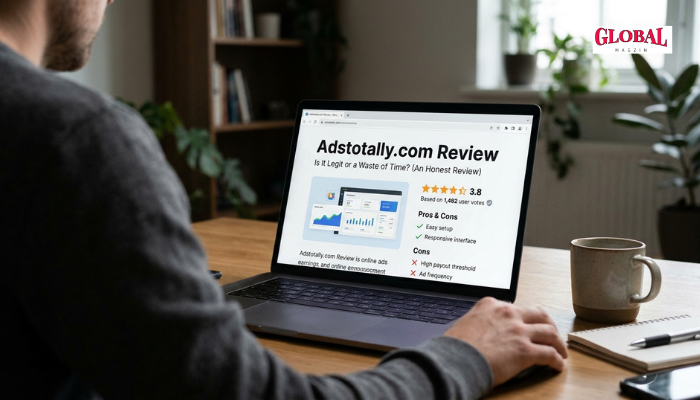
If you searched for Adstotally.com expecting to buy ads or earn publisher revenue, the name may have set the wrong expectation. A person looking for business marketing tools can land on a content site instead, while readers may simply want useful articles. That difference matters before you share payment details or spend time looking for a publisher account.
This review looks at what the live site offers and what remains unclear about its commercial services. It also addresses the pricing question without treating an unlisted rate as a published price. You can use the findings to decide whether the site fits your goal, whether that is reading, advertising, or publishing.
The key question is whether the live site offers the tools your task requires.
What Is Adstotally.com?
Adstotally.com is best understood as a multi-topic content publication, not as a verified advertising service. The site’s domain name may suggest advertising software, but a name alone cannot establish what a business sells. The pages present articles for general readers, with subjects that extend beyond advertising and marketing.
Publishing about advertising does not make a publication an advertising platform. A content site can explain campaigns, business tools, or industry trends without letting advertisers buy placements or website owners earn payouts. That distinction helps you judge the service by its visible features instead of its branding.

A publication can discuss advertising without providing advertising infrastructure.
The site has an established publishing history, with an archive of articles and an About page describing the publication. Its pages are built to be browsed and read, rather than to guide you through a software setup. The published material gives the domain an editorial role, even when individual pages cover commercial topics.
That role is different from a marketing vendor’s role. A publication may carry useful information about business or digital tools, but its articles do not confirm that it offers those tools directly. Treat its branding as a clue to investigate, not proof of what the site does.
Is Adstotally.com an Advertising Network?
No advertiser or publisher account system is visible on Adstotally.com, so it does not function as a verified self-service ad network. A self-service advertising platform lets advertisers create and manage campaigns through online tools. The domain does not show an advertiser sign-up, campaign builder, publisher dashboard, or API documentation.
A publisher dashboard is an account area where a website owner manages ad placements and checks earnings. A working advertising platform usually lets an advertiser set a budget, choose targeting, enter billing details, and review campaign performance. Publishers commonly receive ad tags, placement controls, and earnings reports.

Google Ads is an example of an advertiser-facing campaign service: advertisers can set up campaigns and manage their delivery through its tools. That comparison is about function, not an endorsement. On Adstotally.com, the visible experience is pages to read, not campaign settings or publisher payment reports.
The difference matters when a service asks you to register. A company may publish articles about advertising and still have no network, platform, or account system behind the name. For a closer example of a technology blog that is not a confirmed software product, see this review of QuikConsole.com.
Before sharing credentials or payment details, confirm that an account portal belongs to the exact service you intend to use.
What Can Readers Do on the Site?
A visitor can browse the homepage feed, choose a category, and open an article without creating an account. The site works as a website for reading content, not as a marketing tool with reader-facing campaign controls. Its navigation gives you a way to explore topics and select pages that match a current interest.
The nine primary categories are Technology, Entertainment, Business, Health, Finance, Travel, Education, Lifestyle, and Real Estate. A separate category is labeled “Adstotally.com.” The site runs on WordPress with the GeneratePress theme, a setup detail that does not add a special reader tool.

| Category grouping | Examples of coverage | Reader use | Limitation |
|---|---|---|---|
| Technology and Business | Cloud storage, digital notebooks, small-business grants | Introductory explainers | Not a dedicated specialist resource |
| Finance and Health | Portfolio diversification, wellness, healthcare environments | General background | Verify consequential claims with qualified sources |
| Lifestyle and Entertainment | Fashion, career development, entertainment | Light general-interest reading | Subjects vary widely |
| Travel, Education, and Real Estate | Travel, Education, Real Estate | Browse available posts by subject | Fewer posts than the site’s more prominent areas |
Category pages help you narrow the feed, but a category label does not promise a fixed level of depth. A technology article may be an overview rather than a hands-on comparison. That makes the article itself more useful to assess than the breadth of the menu.
Use the category menu to find a starting point, then judge the individual article rather than assuming every section has equal depth.
How Does the Site Earn Revenue?
Adstotally.com appears to earn revenue from advertising shown alongside its own content, rather than by paying outside website owners. The site displays third-party display ads on its pages, which makes it an ad consumer. That is not the same as operating an advertising network that places ads across other publishers’ websites.
Display placements and native advertising can support a blog or publication by earning money from the audience reading its pages. The About page also identifies sponsored content and advertising as content types. Those labels describe possible material on the site, but do not establish the terms of a particular paid placement.
For readers, the distinction is practical: seeing ads on a site does not mean the site offers an account for publishers. A publisher revenue program would need its own terms and payment process. Those features are not visible as a public service here.
Visible pricing and the exact labeling details for sponsored material are not established on the site. An article may discuss a product or service without making the commercial relationship clear from its headline alone. A commercial content category does not, by itself, tell a reader how a particular sponsored article is labeled.
What Does Adstotally.com Cost?
Casual readers can browse without an account or paywall, but Adstotally.com does not show a public price list for advertising services. The site has no visible self-service campaign checkout or public rate card. Readers can access its pages without paying a subscription fee.
Free reading does not establish a price for business services. A possible advertising deal, publisher arrangement, or guest post placement would be a separate commercial offer. The site does not publicly state a guest-post price or the terms of a placement.
That means you should not treat an informal quote or a third-party listing as an official price from the site. The seller, the exact page, and the promised work can affect commercial terms. A published price would need to identify what you receive, rather than simply naming the domain.
For a reader, the cost is straightforward: browsing does not require a payment or account. For an advertiser or publisher, there is no public menu of tools or rates to compare. Do not commit money until the provider identifies the exact deliverable and its terms in writing.
Is Adstotally.com Safe to Visit?
The site had active HTTPS and no active malware or phishing flags in the checks described, which supports ordinary cautious browsing. HTTPS encrypts the connection between your browser and the website. It does not prove that every ad, redirect, or outside destination is safe.
A clean scan is a time-specific signal, not a guarantee about every page or ad. Google Safe Browsing and VirusTotal showed no active malware or phishing flags at the time checked. That status can change, and third-party display ads may lead away from the site.
For ordinary reading, you can use your browser’s tracking protections if you want to limit ad tracking. Pay attention when an ad opens a new page or asks you to download something. A safe connection to the publication does not certify the destination selected by an advertiser.
Do not enter payment credentials into an unexpected pop-up, even when it appears beside a familiar article. Close a page that suddenly asks for private details or urges an urgent download. If an ad redirects unexpectedly or asks for sensitive information, close it rather than continuing.
Is the Content Reliable?
The articles may be useful for a quick introduction, but visible bylines alone do not establish subject-matter expertise. The writing is generally accessible and often introductory, which can help readers understand a topic’s basic terms. That level of content is not a substitute for expert-backed advice.
Bylines checked include “suman” and “adstotally,” and those names do not link to author bios or credentials. Without visible expertise, you cannot tell from the byline alone whether an author has relevant training. That matters most when an article addresses health, finance, or another high-stakes subject.
| Check | What a reader can see | What it means | Sensible reader action |
|---|---|---|---|
| Author identity | “suman” and “adstotally” bylines without linked bios | Credentials are not established by the byline | Look for named expertise elsewhere |
| Depth | Broad explanatory articles | Useful for orientation, not necessarily specialist guidance | Confirm important details |
| Original reporting | No clear interviews or first-hand testing in the material reviewed | Independent evidence is limited | Seek primary evidence for consequential claims |
| Topic breadth | Health, finance, business, and lifestyle subjects | Expertise may not transfer across fields | Check each article’s author and references |
Accessible language can make an article easy to follow, but it does not show how a claim was checked. Look for named references, linked research, and clear explanations of where figures come from. Broad coverage also means a writer’s experience in one area may not apply to another.
A related review of a multi-topic publication also discusses how limited author information affects trust in health and finance coverage. The useful rule is to separate a readable overview from a recommendation that could change your choices. For health or financial decisions, verify advice with a qualified professional or authoritative specialist resource.
Is Adstotally.com a Legitimate Business?
Adstotally.com is a real, functioning website, but that does not verify every business description attached to it. The site has an About page and published archives, which show an operating publication. Those details do not independently confirm the company behind the domain or every service someone may offer under its name.
The About page states that the publication was founded in 2023, while the site archive includes posts dated as early as September 2020. The dates do not line up neatly, but that mismatch does not prove a change of ownership. The archive could reflect earlier publishing activity under a different history.
A live website confirms that pages exist, not that ownership claims are verified. WHOIS privacy shields the domain registrant’s identity from public lookup. That means public registrant details alone cannot confirm the operating company or identify who controls the publication.
Search results and repeated brand descriptions can make a domain seem more established or more product-focused than its own pages show. For a similar distinction between a functioning website and claims about its purpose, see this review of a multi-topic publication. The comparison is useful for judging transparency, not as evidence about Adstotally.com’s ownership.
Treat its ownership and precise history as unresolved unless the operator provides verifiable documentation.
Are Guest Posts and Backlinks Worth It?
A guest-post offer is worth evaluating page by page, because the domain’s overall metrics do not guarantee the performance of a new article. Domain-level traffic estimates describe a whole site, not the visits a new page will attract. They also cannot promise that a page will rank or reach your target audience.
Do not buy based only on a domain authority or traffic metric. Inspect recent articles in the category where your post would appear. Check whether those pages are indexed, visible for non-branded search terms, relevant to your audience, and edited to a consistent standard.
Guest-post placements associated with the domain have appeared on third-party marketplaces. That does not confirm that a current seller is authorized, that a placement remains available, or that the terms are the same across offers. The site does not publicly state placement pricing or link terms.
Before paying, get the seller’s authority, link attributes, retention and removal terms, and editing rights in writing. Ask which page will carry the article and what happens if the page changes. A placement’s link treatment should be clear, not inferred from a marketplace description.
Google identifies paid links intended to manipulate search rankings as link spam. A paid placement might still have value for readers when it reaches a relevant audience, but it should not be sold as a guaranteed ranking gain. If the placement’s value depends only on passing ranking signals, do not treat it as a risk-free SEO purchase.
How Does Adstotally.com Compare With Ad Platforms?
The clearest difference is that Adstotally.com publishes articles, while the other services in the comparison provide advertising or publisher tools. It has no advertiser or publisher account found on the domain. Publishing about advertising is not the same as providing campaign or payout infrastructure.
Choose based on the account you need: campaign management or website monetization. Google Ads provides advertiser campaign tools, while Google AdSense supports publisher ad monetization. Ezoic offers publisher ad testing and optimization, and Mediavine is a publisher ad-management network.
| Service | Main role | Advertiser campaign account | Publisher monetization account |
|---|---|---|---|
| Adstotally.com | Editorial content publication | None found | None found |
| Google Ads | Advertiser campaigns | Yes | No publisher payout account |
| Google AdSense | Publisher ad monetization | No advertiser campaign builder | Yes |
| Ezoic | Publisher ad testing and optimization | No advertiser campaign builder | Yes |
| Mediavine | Publisher ad management | No advertiser campaign builder | Yes |
The roles in the table are not interchangeable. An advertiser campaign account helps a business manage ad buying, while publisher tools focus on earning from a website. Adstotally.com fits neither account role based on the functions visible on its domain.
For your next step, decide whether you need to buy campaigns, monetize a website, or simply read about marketing. The site can serve the reading goal, but the account types above belong to services built around advertising work. Match the service to whether you need to buy campaigns, monetize a website, or simply read about marketing.
Which Alternatives Fit Your Goal?
Choose an alternative by the task: launching campaigns, earning from a website, or keeping up with marketing news. For a publisher comparing monetization options, Raptive is a full-service ad-management option for established publishers. PropellerAds offers specialized formats, including push notifications, pop-unders, and interstitials.
Those services solve different problems, so they are not interchangeable. A publisher should assess Raptive’s eligibility and current terms directly. A marketer evaluating PropellerAds should compare its formats with the audience and placements they want, rather than treating every ad format as equally suitable.
Choose an advertising service for the job it performs, not for a name that sounds relevant.
For digital marketing and search coverage, explore Search Engine Journal, Search Engine Land, and Adweek. These publications cover marketing, search, and advertising news, making them useful places to follow industry developments. Their editorial role differs from a campaign tool or a publisher monetization platform.
A search engine publication can help you follow changes in search and marketing, but it will not manage your advertising account. An ad platform may deliver campaigns without providing broad editorial coverage. Keep those needs separate when comparing tools, platforms, and publications.
Before signing up, compare each provider’s current eligibility rules and format against the audience you actually want to reach.
Conclusion
Adstotally.com is a working content site, but its name promises more advertising functionality than visitors can verify. The clearest takeaway is that it is best approached as a multi-topic publication, not as a confirmed campaign or publisher revenue service.
If you want general reading, open a specific article and assess its usefulness for your purpose. If you need advertising or monetization, check that a provider’s visible account tools match the work you plan to do. Decide what you need first, then use a service whose visible features match that job.